# A restaurant menu
> Dishes by course, with price, photo and allergens, from a content type.
Source: https://uglydev.com/recipes/a-restaurant-menu/
Updated: 20 November 2026
**What you build.** A menu with dishes, sorted by course (Starters, Mains, Desserts), each with a price, a photo, allergens and a vegan badge. Editors add dishes like posts. The page of the menu prints them by course.
**What you use.** A content type, a taxonomy, one field group, `ugly_find()`.
## Step 1. The content type
1. **UglyFields → Content types → New content type**.
2. Choose **A list of things**.
3. Change the example: singular `Dish`, plural `Dishes`, key `dish`.
4. In **Parts of the editing screen**, keep **Title** and **Featured image**, and turn off **Content editor**. The fields will be all there is.
5. In **Addresses on the site**, set **Start of the address** to `menu`.
6. **Create**.

*The New content type form filled in for Dish.*
## Step 2. The taxonomy
1. Open the **Taxonomies** tab, then **New taxonomy**.
2. Choose **Categories**.
3. Singular `Course`, plural `Courses`, key `course`. Under **Content types**, tick **Dish**.
4. **Create**.
Make three courses from the new **Courses** screen of the Dishes menu: Starters, Mains, Desserts.
## Step 3. The fields
1. **UglyFields → Field groups → New group**. Name it `Dish details`.
2. Add:
- **Number** `Price`, with **Smallest number** `0`, **Step** `0.5` and **Text before the box** `€`.
- **Checkboxes** `Allergens`, with choices typed one per line: `gluten`, `dairy`, `nuts`, `eggs`.
- **Yes / No** `Vegan`.
- **Text area** `Description`.
3. **Location** → **Post type is Dish**.
4. **Create group**.
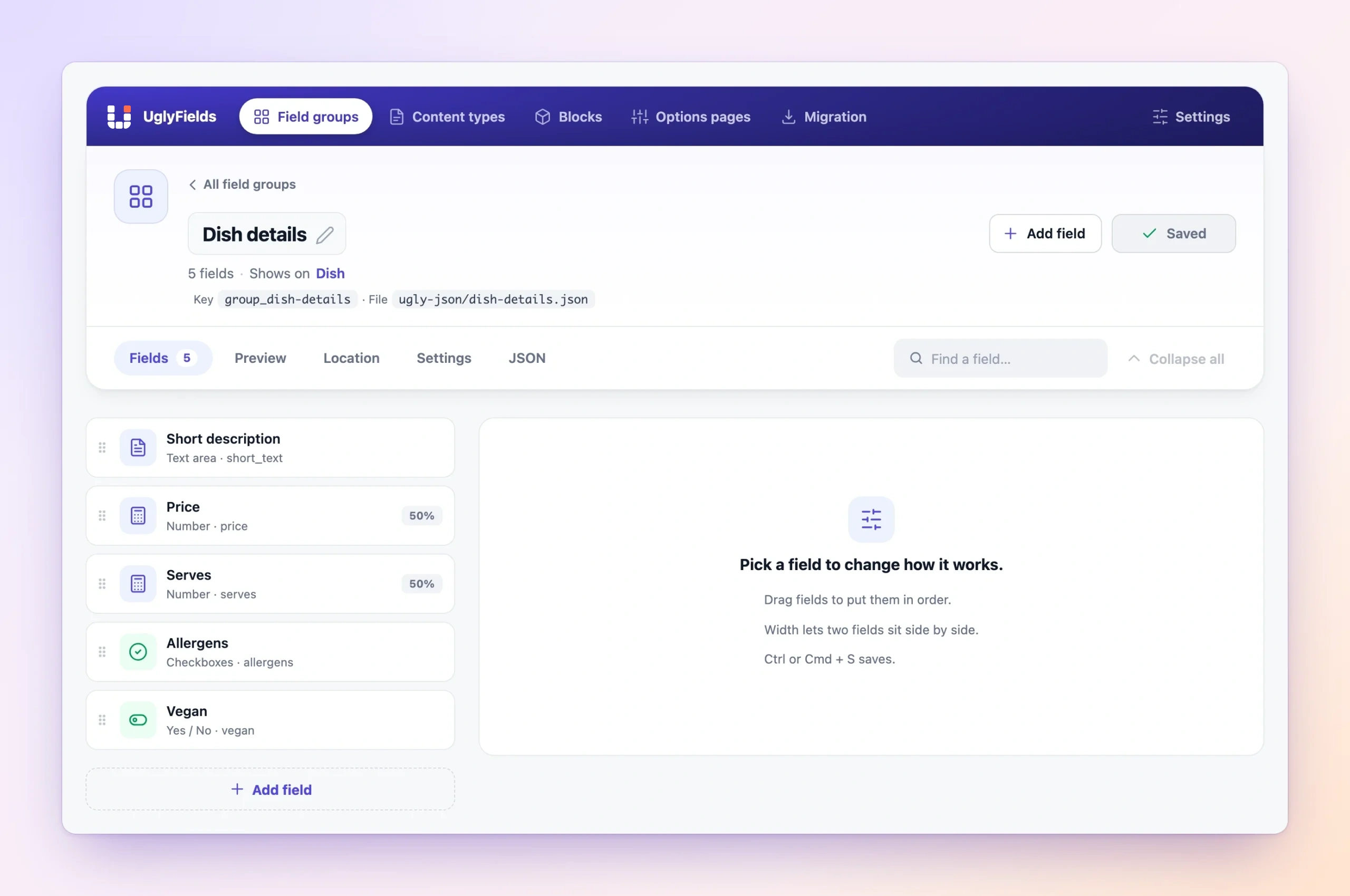
*The builder with the fields of Dish details.*
Now add a dish: **Dishes → Add new**. The fields are there.
## Step 4. The template of one dish
`single-dish.php`:
```php
€
Vegan
Contains:
```
## Step 5. The menu page, by course
`page-menu.php`:
```php
Menu
'course', 'hide_empty' => true ) );
foreach ( $courses as $course ) :
$dishes = new WP_Query(
array(
'post_type' => 'dish',
'posts_per_page' => -1,
'orderby' => 'title',
'order' => 'ASC',
'tax_query' => array(
array(
'taxonomy' => 'course',
'terms' => $course->term_id,
),
),
)
);
?>
name ); ?>
have_posts() ) : $dishes->the_post(); ?>
€
```
> **Tip:** a normal `WP_Query` is the right tool to filter by a taxonomy. `ugly_find()` is for filtering by the **values of fields**, as the next step shows.
## Step 6. Only the vegan dishes
```php
$vegan = ugly_find( 'dish', array( 'vegan' => true ), array( 'order' => 'price asc' ) );
```
## What you learned
- A content type, a taxonomy and a group are three separate things that work together by **location**.
- `ugly_find()` gives you a `WP_Query` and takes conditions on **fields** as an array. For a taxonomy, use a normal `WP_Query`.
- Everything you made is in `ugly-json/`, ready to commit.