# How to make a repeater field in WordPress
> A repeater is a list of rows that all have the same fields: a team, a price list, a FAQ. This is how to make one in WordPress, print it with a plain foreach, and keep the code readable.
Source: https://uglydev.com/blog/wordpress-repeater-field/
Updated: 22 November 2026
## In short
- A repeater is a list of rows with the same fields: a team, prices, a FAQ.
- You make it in the builder in minutes, and the editor gets Add row, drag and remove.
- In the theme it is a plain foreach over ugly_rows(), with nothing hidden in a loop.
- The repeater is free. Flexible content, for blocks of different kinds, is Pro.
A repeater field is a list of the same small set of fields: team members, prices, steps, questions and answers. WordPress does not have one built in. This is how to **make a repeater field in WordPress** with a free plugin, put it on any page, and print it in your theme with a plain `foreach`. No meta box to write, no JavaScript, no hidden loop.
## What a repeater field is
Most custom fields hold one value: a headline, a price, a picture. A repeater holds **a list of rows**, and every row has the same fields. The editor presses *Add row* as many times as needed, drags the rows into order and removes the ones they do not want.
You reach for one whenever the number of items is not fixed:
- **A team page:** a name, a role and a photo for each person.
- **A price list:** a plan, a price and what is included.
- **A FAQ:** a question and an answer, as many as the page needs.
- **A slider or a set of steps:** an image, a title and a line of text for each slide.
## Why WordPress does not give you one
WordPress stores custom fields as post meta: one key and one value. A list of rows has no place in that, so you have to build it. Doing it by hand means a meta box, some JavaScript so the editor can add, remove and reorder rows, a nonce, sanitising every value on the way in and escaping it on the way out. It can be done, and plenty of developers have done it once per project.
> **Fair is fair:** If you need one repeater on one site and you are happy to maintain that code, a hand-written meta box is fine and has no dependency. A plugin earns its place when you have several repeaters, several sites, or editors who need the rows to behave well.
## Make a repeater field in five steps
This uses [UglyFields](https://uglydev.com/download/), which is free, and it takes a few minutes. We will build a team list.
### 1. Install the plugin and make a group
Install and activate UglyFields. Open **UglyFields → Field groups → New group** and choose **Fields for pages and posts**. Name the group *Team*. In **Location**, say where it shows up: a page, a post or your own content type.
### 2. Add a Repeater field
Press **Add field**. A window opens with a search box and the kinds of field. Type *list* or find **Repeater** among the popular ones. It is added to the end of the group, ready to name. Call it *Team*.
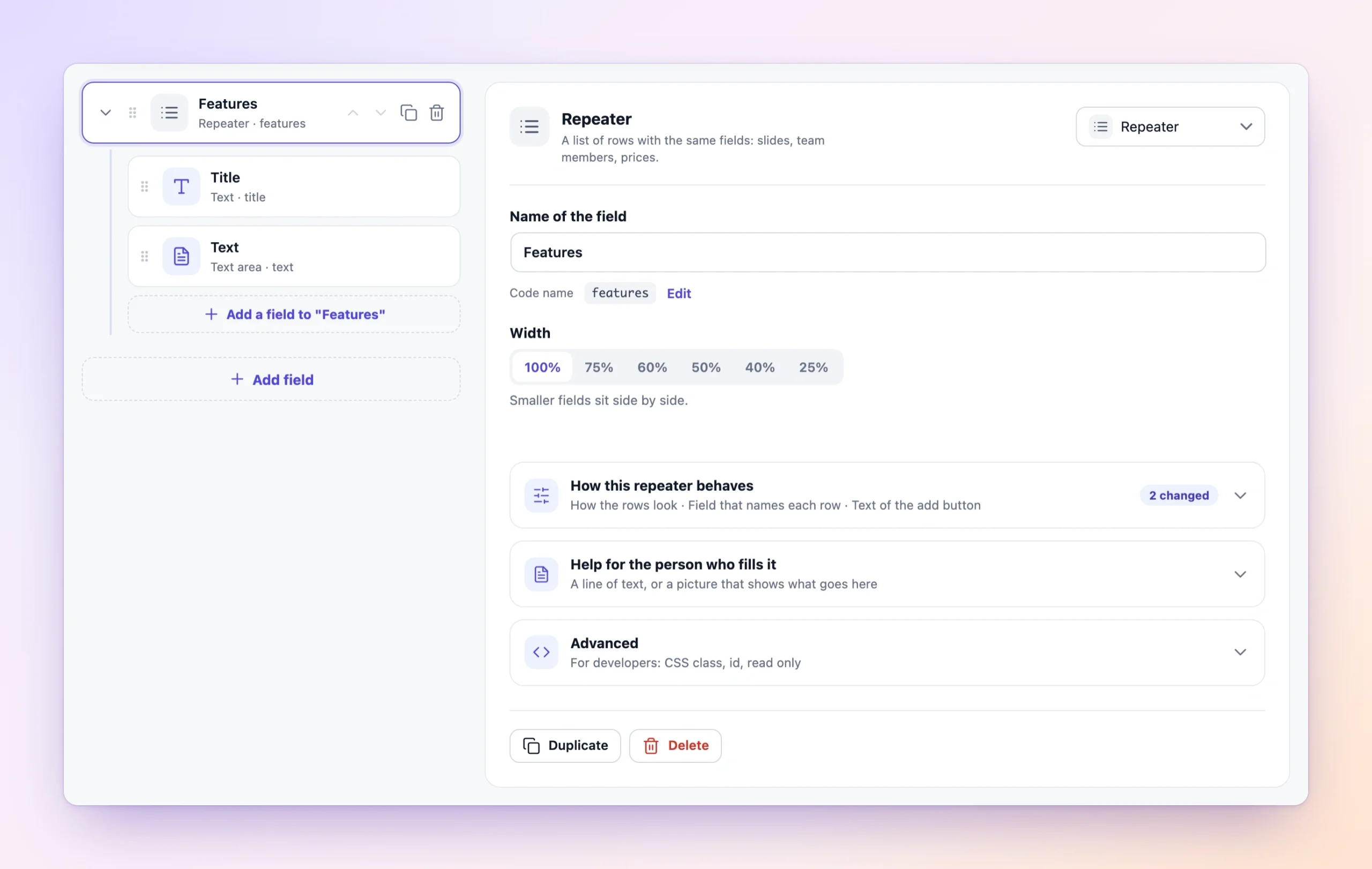
*A repeater in the builder, with its fields inside it.*
### 3. Add the fields of one row
Inside the repeater, press **Add a field** for each thing a row has. For a team: *Name* (Text), *Role* (Text) and *Photo* (Image). Every row will have exactly these three.
### 4. Choose how it behaves
The repeater has a handful of settings, in plain words:
| Setting | What it does |
| --- | --- |
| **How the rows look** | Cards put the fields one under the other. Compact puts them side by side, which suits rows with a few short fields. |
| **Field that names each row** | Its text is shown on the row, so you can tell the rows apart when they are folded. Pick *Name*. |
| **Text of the add button** | Say *Add a person* instead of *Add row*. |
| **Fewest rows needed** and **Most rows allowed** | The editor starts with the minimum and cannot go past the maximum. Zero means no limit. |
### 5. Fill it in
Edit a page that has the group. The repeater shows as a list with *Add row* at the bottom. Each row can be dragged, folded, duplicated and removed.
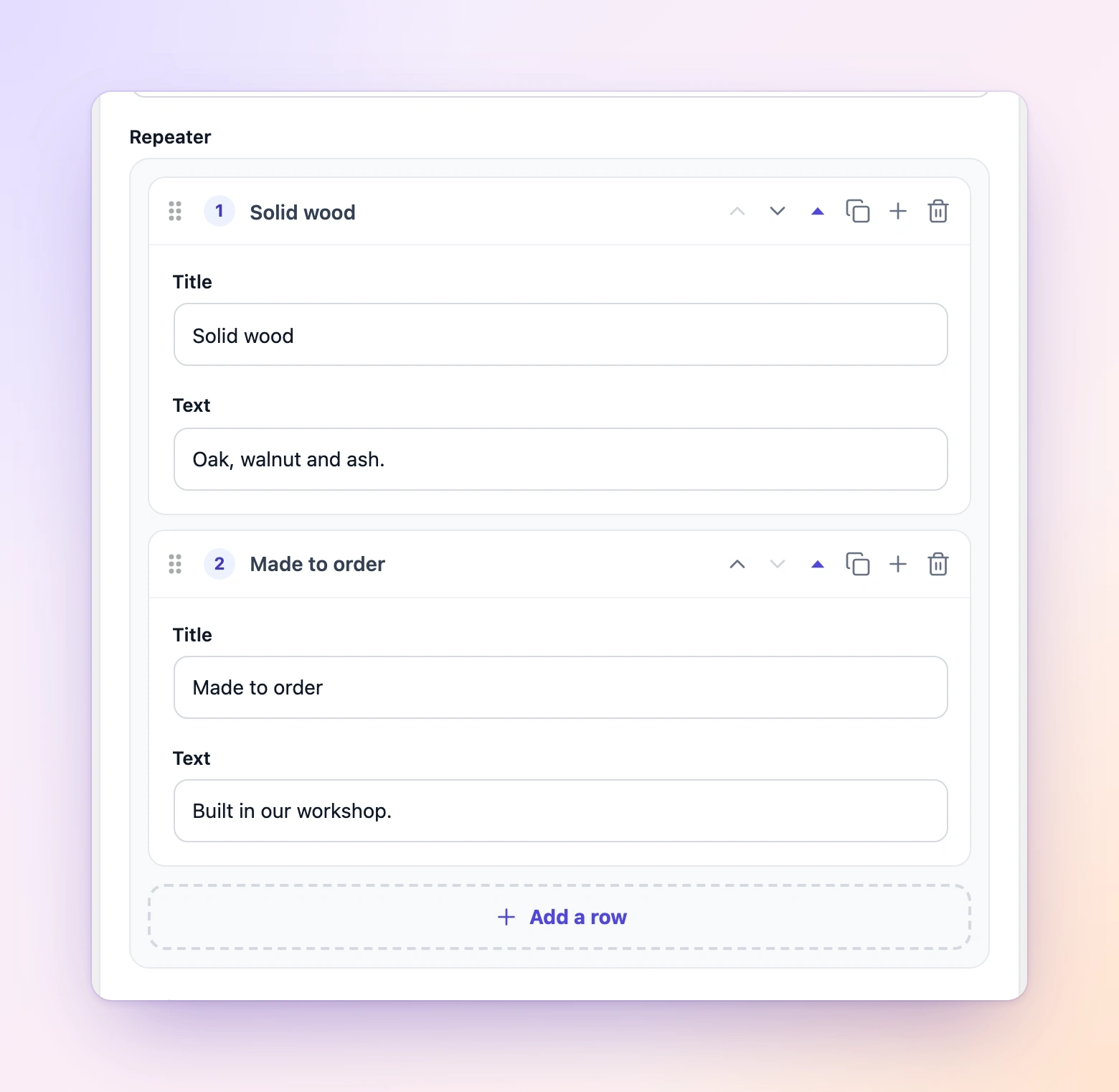
*What your editor sees.*
## Print the rows in your theme
This is the part that matters for the code you keep. A repeater is a list, so you loop over it with `foreach`:
```php
show( 'name' ); ?>
show( 'role' ); ?>
```
Three things to notice:
- `show()` prints the value **already escaped** for its type, so you do not wrap it in `esc_html()`.
- `ugly_rows()` always gives a list. If the page has no rows, or the field is not there at all, the list is empty and the loop simply does not run. No `if`, no warning.
- There is no `have_rows()` and no hidden pointer. A repeater is a list, and a list is looped with `foreach`.
To print something only when it is filled in, ask the row:
```php
has( 'photo' ) ) : ?>
get( 'photo' ), 'thumbnail' ); ?>
```
## Pass a row to a template part
In the old style, the current row lives in a hidden state that only exists inside the loop, so a template part that reads it has to be called from inside that loop and nowhere else. Here a row is just a variable, so you hand it over:
```php
foreach ( ugly_rows( 'team' ) as $member ) {
get_template_part( 'template-parts/team-member', null, array( 'member' => $member ) );
}
```
And in `template-parts/team-member.php`:
```php
show( 'name' ); ?>
```
If you are coming from ACF, this is the translation:
| In ACF | In UglyFields |
| --- | --- |
| `while ( have_rows( 'team' ) ) : the_row();` | `foreach ( ugly_rows( 'team' ) as $member ) :` |
| `the_sub_field( 'name' );` | `$member->show( 'name' );` |
| `get_sub_field( 'name' );` | `$member->get( 'name' );` |
Moving a whole site is covered in [Thinking about leaving ACF?](https://uglydev.com/blog/thinking-about-leaving-acf/).
## A repeater inside another
A row can hold its own repeater. A menu has categories, and each category has dishes:
```php
show( 'title' ); ?>
rows( 'dishes' ) as $dish ) : ?>
show( 'name' ); ?>
```
The limit is one level: a repeater can hold another repeater, but not a third inside those two. If you feel you need a third, a **group** field is the way to organize it.
## Add a row from code
Sometimes the rows come from somewhere else: an import, a form, a script. Read the rows, add yours, and write the whole list back:
```php
$post_id = 42;
$rows = array_map(
static fn ( $row ) => $row->toArray(),
ugly_rows( 'team', $post_id )
);
$rows[] = array(
'name' => 'Marta',
'role' => 'Waiter',
);
ugly_update( 'team', $rows, $post_id );
```
A row cannot be changed in place (`$row['x'] = 1` does nothing), which keeps reading and writing clearly apart. `ugly_update()` is how you write.
## Repeater or flexible content?
A repeater is a list of rows that are all the same. If a page needs blocks of **different kinds** in any order (a hero, then text, then a gallery), that is **flexible content**, where each row knows its kind with `layout()`. The repeater is part of the free plugin. Flexible content is Pro.
## Habits that keep a repeater pleasant
1. **Name each row.** Pick a field that names it, so folded rows read as a list and not as “Row 1, Row 2”.
2. **Keep rows small.** A repeater is for repeating things. A row with twenty fields wants to be a content type of its own.
3. **Set a maximum when there is one.** A slider with six slides should not let someone add sixty.
4. **Print with `foreach`, not by index.** The editor reorders rows; position is not an identity.
5. **Hand the row to a template part** when the markup grows. Your loop stays short.
## A complete example: a team grid
Putting it together, here is a whole template part: a list with a photo when there is one, and a friendly line when the page has no team yet.
```php
-
has( 'photo' ) ) : ?>
get( 'photo' ), 'medium' ); ?>
show( 'name' ); ?>
show( 'role' ); ?>
The team page is coming soon.
```
The list is truthy only when it has rows, so the empty case takes one `else`. Nothing here needs a counter, a pointer or a reset at the end of the loop.
## A repeater, or a content type of its own?
Both hold “many of the same thing”, so it is worth choosing on purpose. Use a **repeater** when the items only make sense on one page and the editor never needs to open one by itself: the steps of a process, the logos in a row, the questions of a FAQ.
Use a **content type** when each item deserves its own address, its own page, a place in search or an archive: team members with their own profile, products, events. You can still list them on another page, and the [content type guide](https://uglydev.com/docs/how-to-make-a-content-type/) shows how to make one. A simple rule: if you would ever want to link to a single item, make it a post, not a row.
To pick the right kind of field for everything else on the page, read [every field type in one minute](https://uglydev.com/blog/every-field-type-in-one-minute/). To find posts by what is inside their fields, see [stop writing meta_query](https://uglydev.com/blog/stop-writing-meta-query/).
> **Where it is documented:** [How to use a repeater](https://uglydev.com/docs/how-to-use-a-repeater/) goes step by step, and [Rows: repeater, group and flexible content](https://uglydev.com/docs/php-api/rows-repeater-group-and-flexible-content/) lists everything a row can do.
## Questions people ask
### Does WordPress have a repeater field?
Not in core. WordPress stores one value per custom field key, so a list of rows needs a meta box you write yourself or a plugin that provides it.
### Is the repeater field free in UglyFields?
Yes. The repeater is part of the free plugin. Flexible content, which lets the editor add blocks of different kinds, is Pro.
### How do I loop over a repeater in my theme?
Use foreach over ugly_rows('team') and print each value with $row->show('name'). The list is empty, never an error, when there are no rows.
### Can a repeater have a repeater inside it?
Yes, one level: a repeater can hold another repeater, but not a third. Use a group field to organize anything deeper.
### How do I limit the number of rows?
Set Fewest rows needed and Most rows allowed in the settings of the repeater. Zero means no limit.
### Can I add rows from code?
Yes. Read the rows with ugly_rows(), turn each into an array with toArray(), add your own and write the list back with ugly_update().